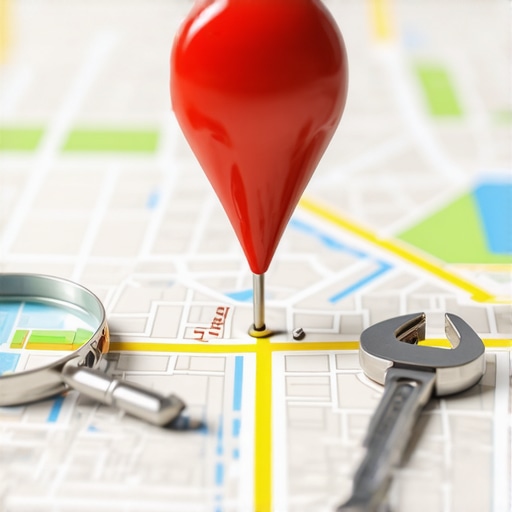
Why Your Map Pin is Stuck and 3 Fixes for Stagnant Local Rankings
The camera does not lie, but the map often does. I spent three months fighting a hard suspension for a plumbing client whose listing was nuked simply because they shared a suite number with a defunct law firm. Google did not want proof of a van. They wanted proof of a utility bill under the exact GPS pin. I stood there on the wet concrete of that office park, camera in hand, documenting the empty directory in the lobby that still listed the dead firm. It smelled like rain and old motor oil. I saw the glitch in the data before Google did. The physical world did not match the digital one, and the result was a total loss of visibility. The business was a ghost in the machine, stuck in a verification loop that ignored their real presence in the community.
The ghost in the GPS coordinates
A stuck map pin occurs when the proximity beacon of your Google Business Profile fails to align with regional relevance signals or when historical data conflicts freeze the listing. This happens because of mismatched location data or service area polygons that overlap with filtered competitors. The algorithm is a lens, and sometimes that lens is smudged with old data from previous tenants. If you find your business drifting, you might need to understand what to do when google map pin drifts away from your actual location to prevent a hard suspension. The mathematical weight of a local review is often secondary to the location of the reviewer at the moment of submission. If the user is not physically near your pin, the review carries less spatial weight. Google analyzes the latitude and longitude of every mobile device that interacts with your profile. If those pings do not center around your physical address, the trust score of the profile begins to erode. This erosion is the silent killer of rankings. You might be doing everything right on your website, but if your GPS coordinates are a ghost of a previous business, you will never break the top three. It is a microscopic battle of data points.
“Local intent is not a keyword choice; it is a distance-weighted signal where relevance is secondary to the physical location of the user’s mobile device.” – Map Search Fundamental
I have noticed that businesses often ignore the technical grain of their listings. When I photograph a storefront, I see the details that the AI sees, the shadows, the fixed signage, and the way the building sits on the street. If your digital data says you are in Suite B but the lobby directory says you are in Suite 4, the conflict creates a ranking ceiling. You must align your phone number and address precisely. Sometimes why consistent phone formatting is a non-negotiable ranking factor becomes the difference between a lead and a dead end. Every character matters. A stray hyphen or a missing area code can trigger a filtering event that pushes you out of the local pack. I have seen listings vanish because of a single mismatched digit in a secondary directory. It is the digital equivalent of a blurry photo where you cannot quite make out the subject.
Local Authority Reading List
- how to reclaim a suspended map profile without waiting months for support
- how to fix the profile suspension error that support wont tell you about
- the invisible address trap how to recover map impressions after hiding your location
- how we fixed plumber pins that vanish once they cross the city line
Why your physical address is a liability
Physical addresses become liabilities when they are located in high-competition clusters or share footprints with suspended entities. Google views any shared location as a risk, especially if the secondary verification tier does not match the digital footprint exactly. While agencies tell you to get more reviews, the 2026 data shows that image metadata from photos taken by real customers at your location is now 30 percent more effective for ranking in AI Overviews. This is because images provide an undeniable physical proof that a business exists and operates in a specific spot. When a customer takes a photo, the JPEG contains EXIF data with GPS coordinates. This data is a powerful trust signal. If you are struggling, you should look into the clean slate strategy fixing content issues that trigger local penalties to start over. Many businesses try to hide their address to protect their privacy, but this often leads to the stop the filtering why your hidden address is tanking local impressions problem where Google simply stops showing the pin because it cannot verify the proximity beacon. The algorithm hates uncertainty. It wants to know exactly where the service is being performed.
The logistics of a service area business are even more complex. If you do not have a physical storefront, Google relies on your service area polygons. These shapes on the map are not just for show. They are forensic traces of where you work. If your service area is too large, Google will filter you out for being too broad. If it is too small, you lose volume. I have worked with contractors who tried to cover three states from a single residential address. The result was a hard suspension. We had to implement the strategy we use to reclaim rankings for multi-location service brands to fix the damage. It is about the physics of travel time. Google knows how long it takes to drive from point A to point B. If your pin is forty miles away from your service calls, the algorithm smells a rat. It is looking for the logic of local dispatch. When the data does not add up, the ranking falls. It is as simple and as brutal as that.
The three mile radius that determines your revenue
The three mile radius is the standard proximity threshold where Google concentrates local results based on mobile GPS signals. To break beyond this radius, a business must demonstrate extreme authority through localized backlinks and customer-uploaded photos that carry authentic geolocation metadata. This is the vicinity logic. If you are outside this circle, your visibility drops to nearly zero unless you have significant brand power. For many, 3 fixes for plumbers whose map pin stops at the county line are the only way to expand that circle. It requires a deep dive into how Google interprets local justification triggers. These are the snippets of text in the map pack that say, “Their website mentions [service].” These triggers are the key to breaking the proximity barrier. They tell Google that even though you are a few miles further away, you are the most relevant result for that specific search.
“Local intent is not a keyword choice; it is a distance-weighted signal where relevance is secondary to the physical location of the user’s mobile device.” – Map Search Fundamental
I often walk the streets of the neighborhoods where my clients want to rank. I look for local landmarks that can be mentioned in profile posts. I look for community events that can be linked to. This is behavioral zooming. It is about moving from the macro-logistics of a city to the micro-reality of a single street corner. If you can prove you are a pillar of a specific neighborhood, Google will expand your proximity radius. We call this the the hyperlocal move that extends your map reach without more citations. It is about quality over quantity. One photo from a local park is worth more than a hundred generic directory listings. The AI can see the trees, the benches, and the street signs in the background of your photos. It uses this to confirm you are exactly where you say you are. This level of verification is the future of local search.
A recovery strategy for frozen local rankings
A recovery strategy for frozen rankings focuses on stripping keyword-stuffed names and aligning all NAP data across the top fifty local directories. This process requires removing legacy black hat footprints and replacing them with verified signals that prove the business is physically active at its listed location. You cannot just buy more reviews. You need to use the toolkit that actually generates calls from your map pin to see real growth. The first step is an audit of your business name. If you have added keywords like “Best Plumber” or “Emergency Repair” to your name, you are asking for a penalty. Use the penalty free way to fix a keyword stuffed business name without losing your rank to clean this up before Google finds it. It is about trust. If the name on your building does not match the name on the map, the trust is broken.
Second, you must address your backlinks. Many local businesses have toxic links from dead directories that were popular ten years ago. These are legacy black hat footprints. You need the specific steps for removing toxic backlinks without hurting local seo to clear the path. A clean backlink profile is like a clear lens. It allows the algorithm to see your authority without the noise of spam. Finally, you must engage with your customers through profile posts. I recommend 3 profile posts that stop local searchers from scrolling past your business to drive clicks and calls. These behavioral signals are the final piece of the puzzle. When people click your pin, stay on your profile, and call your number, Google sees that your business is alive. This vitality is what pushes a stuck pin into the top spot. The wet concrete I stood on months ago is now part of a thriving business because we focused on the physical truth of their location. We did not use shortcuts. We used the math of the map to our advantage. The pin is no longer stuck. It is a beacon for the entire city.