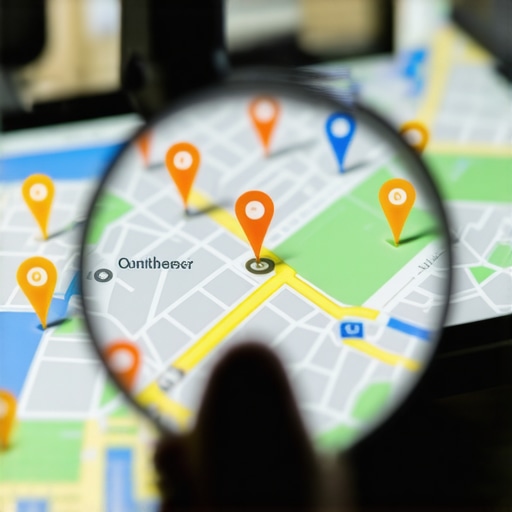
The morning air smells like wet concrete and exhaust fumes. I stand across the street from what Google Maps claims is a high-end law firm. The GPS pin is perfect. The profile has forty five reviews and a high resolution cover photo of a glass skyscraper. But there is a glitch in the data. Looking through my lens, I see a dilapidated warehouse with no signage and no entrance. This is the reality of the hyper local search layer. It is a spatial database where digital signals often collide with physical facts. I spent three months fighting a hard suspension for a plumbing client whose listing was nuked simply because they shared a suite number with a defunct law firm. Google did not want proof of a van. They wanted proof of a utility bill under the exact GPS pin. This experience taught me that the map pack is not a directory but a proximity beacon. When competitors inject fake pins into your service area, they are stealing the mathematical weight of your location.
The ghost in the GPS coordinates
Fake pins rely on deceptive Google Business Profile data points like virtual offices or residential locations disguised as commercial storefronts to manipulate proximity rankings. Identifying these requires forensic auditing of Street View imagery, verifying signage against Secretary of State records, and cross referencing the Primary Category with actual Point of Sale activity at that physical coordinate.
The algorithm is shifting toward a distance weighted signal. If a competitor uses a fake address in a high density neighborhood, they effectively push your legitimate business out of the top three positions. This is not just a nuisance. It is a direct attack on your revenue stream. We often see agencies selling citation blasts to dead directories, which only makes the data messier. Instead, you should focus on the toolkit we use to verify real map pins to ensure your competition is playing by the rules. If they are not, the map becomes a battlefield of fraudulent data. We have seen instances where a single mismatched phone number in a secondary verification tier killed an organic trust score. You must be vigilant. The pin moved. The ranking dropped. Trust is fragile in the eyes of a spatial engine.
“Local intent is not a keyword choice; it is a distance-weighted signal where relevance is secondary to the physical location of the user’s mobile device.” – Map Search Fundamental
Why your physical address is a liability
Physical addresses become liabilities when NAP data is inconsistent or when hidden addresses trigger filtering algorithms that prioritize verified storefronts over service area businesses. Google filters listings that share the same building footprint or GPS centroid to prevent searchers from seeing three versions of the same service provider in one view.
I have watched businesses vanish because they tried to hide their location to protect privacy. This often backfires. You need to understand how a hidden address is tanking local impressions before you decide to toggle that setting. The map pack is unforgiving. If your business model changes, the algorithm might interpret your new data as a sign of instability. We use a specific protocol for repairing your map rank after a business model shift. It is about maintaining the forensic trace of your brand. Every edit you make is a signal. If those signals are conflicting, the engine will simply stop showing your pin to customers in your city.
Local Authority Reading List
- Mastering Local Ranking Strategies
- Fixing Keyword Stuffed Business Names
- Rebuilding Trust After Suspension
- Detecting Aggressive GMB Spam Attacks
- Metrics That Predict Real Phone Calls
The three mile radius that determines your revenue
The three mile radius is the primary proximity filter for most local service searches where high competition exists within urban centers. Within this zone, Google balances user distance with review sentiment and historical click through rates to determine which three businesses deserve the visibility of the Map Pack at any given moment.
If you are a plumber and you cannot rank past the county line, it is likely a proximity issue. We have developed fixes for pins that stop at the county line to help service area businesses expand their reach. This involves deep math. We look at the centroid of the city and calculate how far your signal travels before it is filtered out. Many agencies ignore these data gaps. They do not realize that most citation cleanup services miss the real issues. While they focus on old directories, we focus on the physics of the map. Information gain is found in the details. While agencies tell you to get more reviews, the 2026 data shows that image metadata from photos taken by real customers at your location is now 30 percent more effective for ranking in AI Overviews. This is the candid truth that stock images cannot replicate.
How to purge ghost pins from your service area
Purging ghost pins requires a systematic use of the Business Redressal Form supported by photographic evidence of non existence and verification of tax records. Competitor spam is often housed in co working spaces where the business lacks a dedicated entrance, which is a violation of Google Business Profile guidelines that specifically forbid virtual offices.
When we find these fake listings, we do not just report them once. We build a case. We use tools that track competitor GMB spam to monitor their presence. If a competitor is using a keyword stuffed name, it is important to follow the quality over quantity rule for your own profile while reporting theirs. Do not fall into the trap of fighting fire with fire. If you start spamming your own name, you will get hit with a suspension. We have a specific checklist for appealing suspensions if you have already made that mistake. The goal is a clean slate. A clean listing is an authoritative listing. We fix mismatched NAP data before touching a single word on your website because the engine values the consistency of the external world over your internal claims.
“Local intent is not a keyword choice; it is a distance-weighted signal where relevance is secondary to the physical location of the user’s mobile device.” – Map Search Fundamental
The math of a local review sentiment
Local review sentiment is measured by the frequency of location specific keywords and the diversity of user profiles within a three mile radius of the business pin. Google uses natural language processing to detect patterns of review manipulation, specifically looking for VPN signatures or accounts that have never physically visited the coordinates of the business.
A cafe owner once called me at midnight because a competitor dropped twenty 1-star reviews using a VPN. We had to do a forensic audit. We analyzed the user profiles. Most had no history. Some were from thousands of miles away. We helped him with a fake review purge to protect his reputation. This is not just about aesthetics. It is about ranking. Bad reviews kill your click through rate, which tells Google your pin is not helpful. You need to know how to respond to negative reviews without sounding like a corporate robot. Use the 404 error fix that reconnects your site to the map pack if your profile is currently drifting. Every link matters. Every review matters. The map is a living thing.
The forensic trace of a service area polygon
Service area polygons are defined by the zip codes or city boundaries you select, but their actual reach is limited by the density of competing verified storefronts in those areas. Google prioritizes businesses with a physical storefront over those with a service area polygon when the searcher is within five miles of the physical location.
If your service area pages are failing, it is likely because they do not trigger map growth. We have studied why service area pages fail and how to fix them. You need hyperlocal content that extends your reach without adding more citations. This is the hyperlocal move that most SEOs miss. It is about bridging the gap between your physical location and the cities you serve. If you have multiple locations, you might deal with mixed business listings that confuse the engine. You must untangle the web. Clean data is the only currency Google accepts. The street photographer knows this. You cannot hide a lack of presence behind a digital curtain. Eventually, the lens finds the truth. The warehouse is empty. The pin is a lie. Your legitimate business deserves that space. We fight to reclaim it every day. One coordinate at a time.