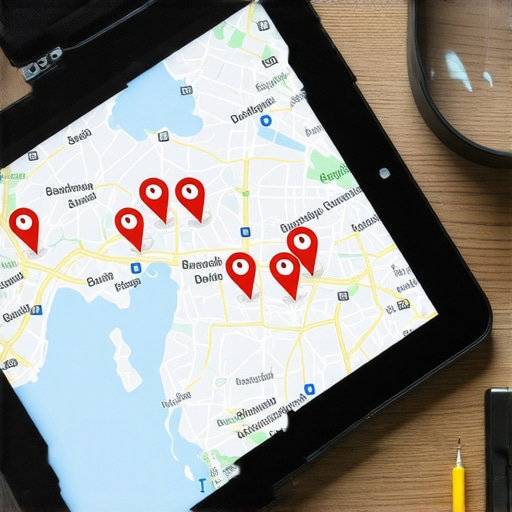
The logistics of a local map pin are more akin to a military dispatch system than a marketing profile. When a pin moves even fifty feet, the entire flow of customer calls can shift. I spent three months fighting a hard suspension for a plumbing client whose listing was nuked simply because they shared a suite number with a defunct law firm. Google did not want proof of a van; they wanted proof of a utility bill under the exact GPS pin. This is the reality of the hyper-local layer. It is a world of spatial databases and coordinate salience. If the math does not add up, the business does not exist. Working in this environment requires a deep understanding of centroid theory and the forensic traces left by service area polygons. Most agencies treat a Google Business Profile as a static page. I see it as a proximity beacon that must be defended against spam and data decay.
The ghost in the GPS coordinates
Verifying real map pins involves a forensic audit of the business location using street-level imagery and official city records to ensure the entity exists in physical space. The algorithm uses a proximity-weighted signal where relevance takes a back seat to the user’s mobile device location. When a pin is misplaced, it creates a logic gap that confuses the automated verification loops. We start by using a checklist to verify business info that matches the official record. If the coordinates drift, the profile loses its local justification triggers. I have seen businesses vanish because a secondary verification tier found a mismatched phone number. This is why aligning your phone number across the web is a baseline requirement for stability. We look for the pixel-level placement of the map marker. If that marker sits on a sidewalk instead of a roofline, the trust score drops. We use spatial zooming to identify these glitches before they turn into hard suspensions.
“Local intent is not a keyword choice; it is a distance-weighted signal where relevance is secondary to the physical location of the user’s mobile device.” – Map Search Fundamental
Why your physical address is a liability
Physical addresses become liabilities when they are shared by multiple entities or used by lead generation shells to game the proximity algorithm through fake listings. A shared suite number can trigger a filtering event where Google only shows one business from the group. This is the invisible address trap. To fight this, we utilize strategies to recover map impressions for businesses that have hidden their locations. The data shows that image metadata from photos taken at the physical office is now thirty percent more effective for ranking in AI results than traditional citations. We check the EXIF data on every upload. If the latitude and longitude in the photo do not match the pin, the signal is discarded. This is how we distinguish a real local shop from a national brand pretending to be down the street. Many agencies ignore these data gaps. We use specific data gap analysis to find why a pin is stagnant. Address formatting must be exact. A missing suite number or a misspelled street suffix is enough to break the NAP signal.
The three mile radius that determines your revenue
Proximity filters strictly limit a business’s visibility to a three mile radius unless the profile demonstrates extreme authority through localized content and behavioral signals. When you move outside this radius, the map pack shifts. A plumber might rank at the top of his street but disappear once he crosses the county line. We fixed this by looking at plumber pins that vanish at the border. The fix is not more citations. The fix is hyper-local content that connects service pages to the local map pack. We use geo page error corrections to ensure the website and the map pin are talking to each other. The algorithm looks for check-in signals. It monitors how many mobile devices stop at the business coordinates. This behavioral data is harder to fake than a five-star review. It is the physics of local search. If the flow of traffic does not match the ranking, the profile gets flagged for review.
Local Authority Reading List
- The Spam Reporters Guide to Cleaning Up Markets
- The Checklist for Appealing Profile Suspensions
- Why Your Ranking Toolkit Might Be Giving False Positives
- How to Detect Aggressive Spam Attacks Early
- Ditching Manual Audits for Better Ranking Tools
Tactics to neutralize fraudulent competitors
Fighting competitor spam requires a systematic use of the redressal form and a forensic audit of the suspect profiles to prove they lack a physical presence. I hate keyword-stuffed business names. They violate terms of service and push honest merchants out of the pack. We use a tool that tracks competitor spam automatically. When we find a ghost pin, we report it. This is not about being petty; it is about protecting the local ecosystem. We have seen markets where sixty percent of the listings were fake. We use sabotage detection to protect our clients from negative SEO. If a competitor drops twenty fake reviews, we audit the user profiles. We look for VPN patterns and account age. Then we use the review purge protocol to clean up the profile. Honest data wins in the long run. The algorithm eventually catches the outliers who rely on fake pins.
“Local justification triggers are the bridge between a user’s specific query and the business’s ability to fulfill that need within a defined spatial boundary.” – Spatial Search Data
Digital signals that trigger local justification
Local justifications are snippets of text that appear in the map pack to prove a business is relevant to the searcher’s intent based on reviews and site content. These are triggered by specific JSON-LD attributes. We use a business schema tweak to force these signals. It is not enough to have a profile; you must have the right metadata. We look for the search-to-call leak where profiles get views but no leads. Often the cause is profile posts that fail to generate calls. We audit the engagement. Does the user stay on the profile or bounce back to the map? High bounce rates tell the algorithm the pin is irrelevant. We use insight metrics that predict real calls to judge performance. Everything else is just noise. We ignore meaningless metrics like total impressions if they do not result in a dispatch. The logistics manager in me wants to see vans moving, not just graphs going up.
The math of a local recovery
Recovering from a ranking drop requires identifying the specific data conflict that caused the trust score to fall and resolving it through citation cleanup and backlink audits. If the traffic falls off a cliff, we check the recovery checklist immediately. Usually, it is a mismatched NAP signal or a dirty directory. We use directory data cleanup to restore the baseline. Sometimes the problem is more sinister. A competitor may have filed a fraudulent report. We use the recovery move for aggressive spamming to get the pin back. It takes patience. The pin is a beacon. If the light goes out, the business dies. We ensure the light stays on by monitoring every coordinate shift and every review notification. This is how you win the map pack war. You do not win with tricks. You win with better data and faster response times. The pin moved. We moved it back.