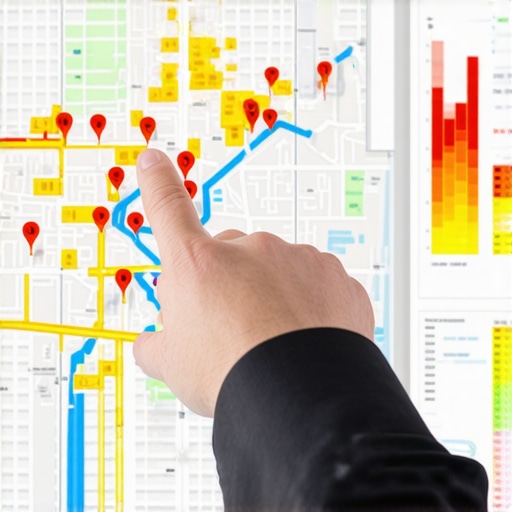
The air smells like wet concrete and ozone from a nearby subway grate. I stand across the street from a storefront where the neon sign flickers with a rhythmic glitch that no rank tracker will ever record. Most people see a business. I see a proximity beacon. I see a set of GPS coordinates fighting for survival in a spatial database that is increasingly hostile to anything that looks remotely like a template. The digital storefront is a fragile thing. It is not just about a name and a phone number. It is about the forensic trace of a physical presence. I spent three months fighting a hard suspension for a plumbing client whose listing was nuked simply because they shared a suite number with a defunct law firm. Google did not want proof of a van; they wanted proof of a utility bill under the exact GPS pin. This was not a data error that a software suite could fix. It was a spatial overlap that required human intervention. The toolkit said the profile was healthy. The reality was that the business was invisible because of a phantom competitor from five years ago. This is why human eyes are the only thing that can save a listing when the algorithm decides you no longer exist.
The ghost in the GPS coordinates
GPS coordinates and latitude-longitude salience determine the primary proximity beacon for a Google Business Profile. While toolkits report on rankings, they often miss the mathematical weight of the centroid, leading to 4th-place stagnation despite high citation consistency. The tool tells you that you are ranking in the top three because you are checking from your office. It does not tell you that your visibility drops to zero once a user crosses the bridge three blocks away. This is why why your google business profile ranking toolkit is giving you false positives remains a primary concern for local owners. The software is looking at a static point. The human looks at the radius. We have to understand that the Vicinity update changed the physics of the map. It is no longer about who has the most reviews. It is about who is the most physically relevant to the searcher at that micro-moment. If your toolkit is not measuring the signal strength at the edge of your service area, it is lying to you. We see these gaps every day. A pin might be perfectly placed, but the data layers underneath it are mismatched. This creates a friction point that the AI identifies as a trust risk. You cannot fix a trust risk with more keywords. You fix it by aligning the physical reality of the business with the digital shadow it casts across the web.
“Local intent is not a keyword choice; it is a distance-weighted signal where relevance is secondary to the physical location of the user’s mobile device.” – Map Search Fundamental
The three mile radius that determines your revenue
Proximity filters and radius-weighted rankings are the fundamental laws of the Map Pack. A service area business often fails to appear because of centroid bias, where Google prioritizes the physical center of a city over the actual service location of the contractor. You might have the best plumbing service in the county, but if your pin is ten miles from the city center, you are fighting a losing battle against the math. This is a common issue we see when why roofing pins vanish after 10 miles and how to reclaim the service area becomes a technical reality. The toolkit says you are optimized. The maps say you are too far away. To break this filter, you have to create hyperlocal justifications that the algorithm cannot ignore. This involves more than just putting a city name in a footer. It involves proving that your team is physically active in those neighboring zip codes. Google looks at the location history of your service vehicles and the metadata of the photos you upload from the field. If those photos do not have GPS tags that match the service area you claim, you are seen as an intruder. The algorithm is a gatekeeper. It wants to see a local footprint that is thick and undeniable. We spend our days digging through this metadata. We look for the technical debt that slows down the connection between a search and a phone call. If your website is lagging, you are losing the race before it starts. This is why 4 mobile speed bottlenecks map performance specialists fix to keep pins visible is a standard part of our audit process. Speed is not just a user experience factor; it is a local trust signal that tells Google your business is ready to serve the customer now.
Local Authority Reading List
- The one profile edit that saves your traffic
- Extending map reach without more citations
- Fixing a massive CTR drop without a rebrand
- The human way to handle bad reviews
- Pushing your pin into the top 3 with backlinks
The invisible wall of service area polygons
Service area polygons and boundary definitions are the primary ways Google understands where a contractor or home service business operates. If your service area business (SAB) listing has overlapping zones with a competitor, Google may filter one of you out to provide search variety. This is the silent killer of rankings. You look at your toolkit and see green checks everywhere. You look at the Map Pack and you are gone. This usually happens because your service area is too broad. You are trying to cover the whole state when your physical authority only extends to three towns. We have to zoom in. We have to look at the specific streets where your customers live. When we evaluate how to evaluate local seo toolkits before you buy, we look for tools that show us the competition density at a street level. If the tool only gives you a city-wide average, it is useless. You need to know which street corner is the boundary of your visibility. This is where the forensics come in. We look at the competitor spam that is crowding you out. We find the fake pins and the virtual offices that are stealing your leads. This is why how map optimization pros purge fake competitor pins without google support is such a high-value skill. You are not just building your own profile; you are clearing the field of invaders. The map is a finite space. There are only three spots in the pack. Every fake business taking up a spot is a direct theft of your revenue. We do not wait for Google to fix it. We use the tools to find the categories and keywords that the spammers are using to trick the system. Then we strike. We report the violations with a level of detail that the automated systems cannot ignore. We provide the proof of the empty storefront or the residential house being used as a commercial office. This is how you reclaim the pack.
The forensic trail of the Map Pack
Map Pack visibility is a result of local justification triggers and entity verification. When a user searches for a specific service, Google looks for mentions in reviews and website content that match the search intent. If your profile lacks these specific triggers, you will not appear, even if your NAP is perfect. This is the nuanced part of the engine. It is not about how many reviews you have; it is about what the reviews say. A hundred five-star reviews saying Great job do nothing for your ranking. Five reviews saying This plumber fixed my leaking pipe in the middle of a snowstorm in Downtown Seattle will move the needle. This is why the local seo checklist items we use to rescue stagnant rankings always includes a review content audit. We are looking for the entities. We are looking for the nouns that Google connects to your service. If your toolkit is just counting the stars, it is missing the point. We also have to look at the technical health of the listing itself. A sudden drop in rankings is usually not an accident. It is a signal of a deeper problem. This is why 3 map optimization pros secrets for fixing sudden drops in map visibility involves checking the secondary verification tier of your Local Services Ads. Often, a mismatched phone number in an LSA account will tank your organic map rankings because Google sees a conflict in the data. They do not know which number is the real one, so they hide both. We have seen profiles vanish because a business owner changed their phone number on a Friday afternoon without updating their website first. The algorithm saw the mismatch and pulled the plug. These are the things a toolkit will never tell you. It just shows a red arrow. The human analyst shows you the fix.
“Local search is a battle of proximity and trust where the algorithm favors the merchant who can prove they are exactly where they say they are.” – Map Ranking Specialist Team
Reclaiming the pin after an ownership change
Listing ownership changes and profile transfers are the most dangerous moments in a local SEO campaign. Any mismatch in credentials or a sudden change in primary categories can trigger an automatic suspension or a proximity filter update that kills visibility. If you buy a business and just change the name on the profile, you are asking for trouble. Google sees a new entity trying to take over the authority of an old one. They suspect a hijack. This is when the hard suspensions happen. This is why the specific checklist we use to appeal google business profile suspensions is the most important document in our office. We do not just submit a utility bill. We submit a narrative. We provide the bill of sale, the state business registration, and a photo of the new owner standing in front of the sign. We provide the forensic proof that this is a legitimate transition. If you are a service area business, this is even harder. You do not have a storefront for them to verify. You have to prove that your home office is a real place of business. This is where how to fix the profile suspension error that support wont tell you about becomes the difference between making payroll and closing your doors. The support team will give you a canned response. They will tell you that you are not eligible. They will not tell you that it is because your address is listed as a virtual office in a secret database they bought from a third party. We have to find that database. We have to fix the source of the error. A toolkit cannot do that. A human who has been in the trenches for twenty years can. We know where the skeletons are buried. We know how to talk to the spam team to get a listing reinstated without waiting for a month of automated rejections. This is the reality of the map. It is a physical space governed by digital laws that are often broken.
The suspension loop for service businesses
Hard suspensions for service area businesses are usually triggered by address inconsistencies or multiple listings in a single residential area. Google uses satellite data and third-party records to verify that a business is not just a lead-gen site or a fake profile. If you are a plumber working out of your house, you are at risk. The algorithm looks at your neighborhood and sees fifty other plumbers. It decides that they cannot all be real. It nukes the newest ones first. This is why how to resolve google maps profile suspension without waiting for support is a required study for any SAB owner. You have to be proactive. You have to build a shield of authority around your pin before the algorithm strikes. This involves having a website that is technically perfect. It involves having local justifications that prove you are real. It involves having a backlink profile that is rooted in your local community, not just a bunch of directory citations. This is where the backlink strategy that actually pushes your pin into the top 3 comes into play. You need links from the local high school, the local chamber of commerce, and the local news station. These are signals that a robot cannot fake. They prove that you are a part of the physical community. When Google sees these links, they are much less likely to suspend your profile for a minor data mismatch. They see you as a pillar of the neighborhood. This is the difference between being a data point and being an entity. A data point can be deleted. An entity must be respected. We focus on building entities. We focus on making sure your business is so deeply woven into the local web that removing your pin would be a mistake. This is the work that toolkits ignore because it is hard. It is messy. It requires making phone calls and sending emails and actually talking to people in the real world. But it is the only way to win in a map that is increasingly crowded with fakes and automated noise. You have to be the signal in the static.