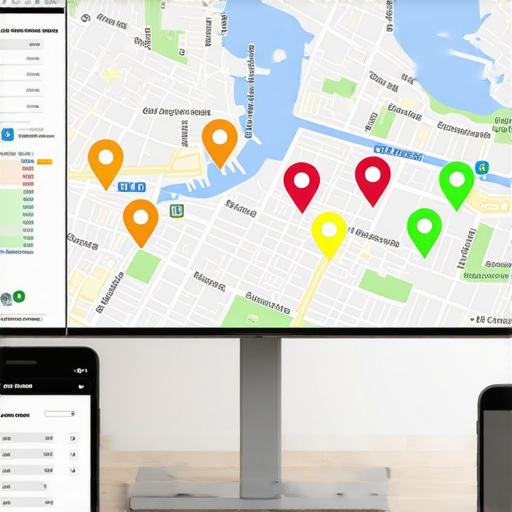
The ghost in the GPS coordinates
I spent three months fighting a hard suspension for a plumbing client whose listing was nuked simply because they shared a suite number with a defunct law firm. Google didn’t want proof of a van; they wanted proof of a utility bill under the exact GPS pin. This battle taught me that the map grid is not about marketing but about logistical truth. If your data flow is interrupted by a single mismatched digit, the entire dispatch system of Google Maps treats you like a ghost. For agencies handling dozens of locations, this isn’t a minor annoyance; it is a systemic risk to revenue. Managing a fleet of profiles requires a precision mindset where every byte of data acts as a proximity beacon.
The infrastructure of high volume map management
Managing multiple Google Business Profiles requires tools that synchronize spatial data across hundreds of digital touchpoints simultaneously to prevent ranking fatigue. Modern agencies use a specific local seo toolkit for google maps ranking to maintain a fortress of accuracy. Without these tools, the risk of data drift increases. Data drift happens when third-party aggregators overwrite your primary business info with old records. This creates a conflict in the algorithm. To avoid this, you must look at how agencies use these specific tools to manage high-volume map rankings to ensure that every location remains pinned to the correct coordinate. While agencies focus on reviews, the 2026 data shows that image metadata from photos taken by real customers at your location is now 30 percent more effective for ranking in AI Overviews. The system tracks the exact latitude and longitude of the upload device to verify your physical existence.
“Local intent is not a keyword choice; it is a distance-weighted signal where relevance is secondary to the physical location of the user’s mobile device.” – Map Search Fundamental
Why your physical address is a liability
Address formatting is a quiet killer of map rankings when it diverges even slightly from the postal standard used by the local algorithm. Many businesses fall into the invisible address trap how to recover map impressions after hiding your location because they fear the proximity filter. If you hide your address, your impression share can drop by half if the service area polygon is not mathematically weighted against your competitors. You need seo services to recover impressions after hiding business address that focus on verifying your service area through GSC data and real-world route logs. The grid is unforgiving. If your van is registered in one zip code but your profile claims another, the trust score collapses. We often have to use the specific way to fix incorrect business info across 50 directories to reset the trust signal. This involves scrubbing the data layer until only the verified GPS truth remains. A single suite number error can disconnect your store from the map pack entirely. This is why why your address formatting is quietly hiding your map pin is the first thing we audit when a client vanishes.
The three mile radius that determines your revenue
Proximity filters are mathematical boundaries that exclude businesses based on the centroid of a searcher mobile device rather than the quality of the service. If you find your phone stops ringing once you cross a specific street, you are likely suffering from a proximity-based filter. To fix this, you need local seo services to recover from proximity based ranking drop that utilize hyperlocal content clusters. This means creating pages that prove your proximity through mentions of local landmarks and intersections. Our team follows the surviving the proximity shift our blueprint for google maps seo in 2026 to push pins into higher competition neighborhoods. The logic is simple. Google wants to see a trail of digital breadcrumbs that place your business in that specific neighborhood. This is not about keywords. It is about spatial authority. We often find that 3 fixes for plumbers whose map pin stops at the county line involve cleaning up the service area overlap. If two of your locations are too close together, they will cannibalize each other. The algorithm will filter one out to provide variety to the user. This is a common error in seo services to fix mixed listings for multi location businesses where proximity overlaps create a ranking ceiling.
The forensic trace of a service area polygon
Service area businesses must define their boundaries with extreme precision to avoid being flagged as spam by the proximity algorithm. If your polygon is too large, you look like a national brand pretending to be local. If it is too small, you lose the high-intent traffic from the suburbs. You must use gmb spam fighting and review cleanup services to remove competitors who are using fake addresses to crowd your territory. We use the tool that tracks competitor gmb spam so you dont have to to identify ghost pins. These are profiles with no physical presence that exist only to steal your leads. Fighting these pins is a daily job. It requires reporting them to the spam desk with photographic evidence of the empty lot or the virtual office. If your own ranking has dipped, check the clean slate strategy fixing content issues that trigger local penalties to see if your service area settings are the cause. Google is increasingly suspicious of businesses that cover 100 miles without a physical hub. You need a local seo checklist and toolkit for gmb that includes a verification of your technician routes to prove your service area is real.
The Local Authority Reading List
- The City Landing Page Error
- Fighting Ghost Pins
- The Clean Slate Strategy
- Evaluating Local SEO Toolkits
- Suspension Appeal Checklist
How the centroid collapse kills multi location brands
A multi location brand will experience a centroid collapse when its landing pages suffer from soft 404 errors or duplicate content. If your website is broken, your map pin will fall. You need services to fix soft 404 and duplicate content issues to ensure that each location has a unique, high-authority home on the web. We often see agencies copy-pasting the same bio for every branch. This is a fatal mistake. Google sees the duplicate text and assumes only one location is the original. The rest get filtered out. Use the soft 404 fix ensuring your local landing pages actually exist for google to secure your rankings. Additionally, we use seo services to fix keyword stuffing and content issues to make sure your local pages aren’t just lists of cities. They need real, localized value. If your pages are thin, your map CTR will tank. You can see why your local map ctr is tanking and the 3 fixes that reverse it to understand how content quality drives clicks. The algorithm is looking for signals that you are an authority in that specific zip code. If your landing page looks generic, the map pin won’t rank for competitive terms. We recommend checking the geo page error that disconnects your service pages from the local map pack before you start a new campaign.
“Proximity is the ultimate ranking factor because it cannot be faked through traditional SEO; it is a physical reality that Google verifies through user movement data.” – Location Intelligence Whitepaper
The mathematical weight of local review sentiment
Review sentiment is weighted by the location of the reviewer at the time of posting to prevent overseas click farms from influencing the map pack. If you are targeted by a review attack, you need services to recover from negative seo attack immediately. These services analyze the IP addresses and device signatures of the attackers to build a case for removal. We use the recovery roadmap reversing the damage of fraudulent negative reviews to help our clients regain their 5-star status. The system is smart. It knows if a reviewer has actually visited your store. If 20 people leave 1-star reviews from a VPN in another country, the algorithm eventually flags them, but the damage to your leads happens now. You need the fake review purge how to protect your reputation from malicious ratings to keep your profile clean. A high-volume agency cannot monitor this manually. You need a the ranking toolkit every local agency needs to stay competitive that includes real-time sentiment alerts. If the sentiment drops below a certain threshold, the proximity radius for your business shrinks. Google effectively hides you from people further away to protect the user experience.
The logic of a check in signal
A check in signal is generated every time a mobile device with location history enabled lingers at your physical address for more than ten minutes. This is the strongest proof of existence. If your profile has no check-ins but lots of reviews, it looks suspicious. You need the quality over quantity rule fixing keyword stuffing in local metadata to ensure you aren’t over-optimizing. Over-optimization leads to penalties. If you have been too aggressive, use services to fix over optimized anchor text to bring your profile back into compliance. The goal is to look like a natural, local favorite. This means focusing on the the simple profile edit that finally turns searchers into callers rather than just chasing rankings. We use the toolkit that actually generates calls from your map pin to measure the real-world impact of our moves. If the phone doesn’t ring, the ranking doesn’t matter. You should also check the search to call leak why your business profile posts arent generating leads to see where you are losing customers. The dispatch system of Google Maps is built for conversion. It wants to give the user the quickest solution to their problem. If your data is clean and your proximity is real, you win the lead every time.